GECCO'nun reddettiği (ve orta not verdiği) paper'i noktasına dokunmadan hesaplamalı mimarlık alanının önemli bir konferansına gönderdim (acadia). mimarlıkla ilgisi zayıf denmiş. doğru. ilerleyen versiyonlar ilgili olacak. "Out of more than 200 entries, we accepted 31 full and 9 work-in-progress
papers." demişler. böyle durumlarda alanla ilgisiz bir paper'in seçilme ihtimali pek yok. ama aslında öyle olumlu reviewlar yazmışlar ki keyifle aşağıya ekliyorum. çalışmayı beğenmişler. eleştirilerin çoğu da yerli yerinde. zamanla eğilmeyi düşündüğüm hususlar. oh keyfim yerine geldi. yapılan iş kendi bağlamında / alanında değerlendirildiğinde zayıf ve kuvvetli yanları daha doğru değerlendiriliyor. kısaca, anlaşılıyor.
----------------------- REVIEW 1 ---------------------
PAPER: 221
TITLE: Generating Layout Arrangements through an Adaptive Multi-Objective Evolutionary Algorithm
AUTHOR: [yazar adını direk yazmışlar!]
I enjoyed this paper and found the research to be interesting, however, the connection to architecture is only indirect. While the problems tackled in this research are relevant to genetic systems in architecture, the application developed here is in graphic design, not architecture, and this makes the paper too distant from the audience of ACADIA. If this paper included a series of architectural examples rather than t-shirt design examples, it would help me greatly to see its implications for architecture, which I think could be significant, but nonetheless remain fuzzy without such examples.
----------------------- REVIEW 2 ---------------------
I did see that any of the results from the methods evaluated had been reviewed by non-automated means to form a baseline.
----------------------- REVIEW 3 ---------------------
This paper explores an interesting application of well-know computational technique (evolutionary computation) to two-dimensional graphic design. The paper is well-written and the experiments performed are well-formulated. The authors clearly understand the technical issues involved in the use of evolutionary computation for design.
Furthermore, in the context of many examples of using evolutionary computation to solve technical and performance-based problems (for example, to design the nose cone of a high-speed train for aerodynamic performance), the paper identifies and investigates a very interesting and unique territory: using evolutionary computation to solve aesthetic problems.
More specifically, several aspects of the experiment details are compelling, including the micro-runs approach, the comparison of the micro-runs approach and the Pareto-based approach, the exploration of adaptive and self-adaptive parameter control, and the analysis of the efficiency and performance cost of different computational processes.
Yet, I believe there are some fundamental issues related to design and computation that the paper might benefit from engaging more fully.
First, as computation becomes more and more embedded in design processes, what are the implications of quantifying features of design such as aesthetics that have traditionally been defined as qualitative? What are the benefits of quantifying aesthetics? What are the limitations? Is producing novel designs the goal? If so, should we be more specific about defining novelty? Does quantifying (and optimizing) aesthetics challenge fundamental definitions of design and designers?
Second, in order to evaluate this design process, it may be helpful to compare it to a more traditional process. In other words, design of graphic layout through multi-objective evolutionary algorithms could be compared to design of graphic layout through direct human intelligence and intuition. What are the benefits and unique characteristics of the algorithmic approach? Again, is novelty the goal? If so, how can the experiment described in the paper demonstrate that the algorithmic approach has produced something novel or helpful compared to a non-algorithmic approach?
Third, in order to evaluate the experiments more specifically, it may be helpful to compare the resulting designs to a few predicted designs. In the use of evolutionary computation, it is very easy to inadvertently set up an experiment that produces only designs that are predictable or already known. The experiment may run successfully, but it will not be very useful. This is often the case when the experiment involves a narrow and simple design space. If the design space is too narrow and too simple, evolutionary computation is not helpful in exploring it. For the experiments described in this paper, I am concerned that their design space is too narrow and I encourage the authors to consider ways to make the design space more broad and/or more complex. More specifically, I am concerned that providing targets (color distribution target and design unit layout target) may overly constrain the design space. In other words, given such specific targets, it may be possible t
o create a hand sketch of the desired outcome without going through the algorithmic process. If the algorithmic process produces results that are substantially different than this hand sketch, or if it resolves issues that are very difficult to sketch (such as very precise fine-tuning of color or spacing), then it would be helpful for the authors to make this more explicit in the paper.
In addition to these major points, here are a few more detailed comments:
For the color fitness histograms, are they applied to the whole image, or on grid system?
For the population size and number of runs for each test, the numbers seem low, as the authors acknowledge. In some uses of multi-objective optimization, the rule of thumb is that the population size should be (2) x (number of inputs) x (number of outputs). Could some tests be run with larger numbers?
In future work, it may be interesting to combine aesthetic fitness criteria with other types of fitness criteria in order to create problems with a design space that is more complex and difficult to easily predict.
design games etiketine sahip kayıtlar gösteriliyor. Tüm kayıtları göster
design games etiketine sahip kayıtlar gösteriliyor. Tüm kayıtları göster
27 Mayıs 2011 Cuma

3 Aralık 2009 Perşembe
"design games" çalışma hayatına böyle başladı (yavrucak) | thus started the toil of the "design games"
these are selected from the first tests, the only tool is color area tool, and is used randomly, as you can see, but what is a tool?


a tool is one of the four atomic elements of design games system (or also framework). another one is the character. tools do, charcters direct. but in fact the separation is far than clear cut. all the atoms, ultimately, are meant to be interchangeable. so that, from the very beginning, a clear cut separation is neither possible, nor desired. and there are also objects, or individuals, in evolutionary terms. they are the alternative products, or designs that are worked on.
and? the games. a game is a compound [come on what kind of atom is it!?] but it could also be interchangeable with the others [possibly self referential?], let's calm down, right now all atoms are discrete and they are not implemented as interchangeable. a game is formed when a character directs a tool and an action is performed on an object.
and these things are produced, the following are also almost random products of the first runs to obtain a desktop icon for design games itself, but i sincerely don't remember which ones were last generation (i.e: evolved, designed) and which are byproducts of the process:


after a thousand runs i started to identify the defects of the system (it's a continuous refining and re-doing process) and then i conducted another series of runs with better character definitions and larger resolution, following are the designs of design games for itself:


the bright colors are not surprising, our character loved them, and it wanted several color areas and it got them. utilized tools were, pattern stamp, gradient, color area and text (i.e. all of them) so we moved on to another task, producing (or designing if you like) a desktop wallpaper for my laptop. again we started with very low resolution trials, these are collected amongst the byproducts, meaning that the poor evaluation capabilities of the systems or coded likings of the characters (by me) prevented their identification as 'fine':





if you didn't notice the images that were produced on previous runs were fed as patterns into these new runs, and only tool was the pattern stamp. and following are the designed ones, look at the differences between these two sets (you can only see it if you go to their pages):





so we went on and on for nights, i was sleeping and design games was working, as appropriate. check the following, they are collected from the garbage of the final runs for a high-resolution desktop wallpaper, different high resolution patterns are added to the system, and that's all:
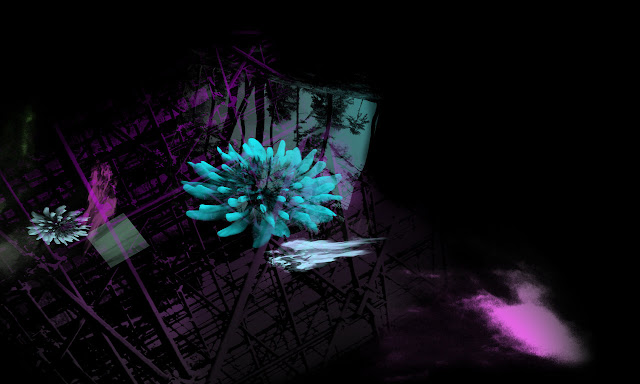


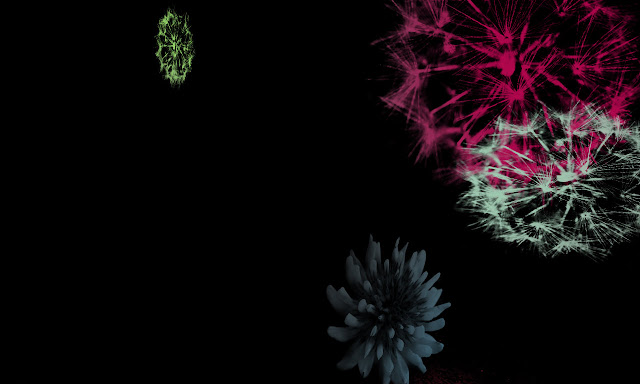
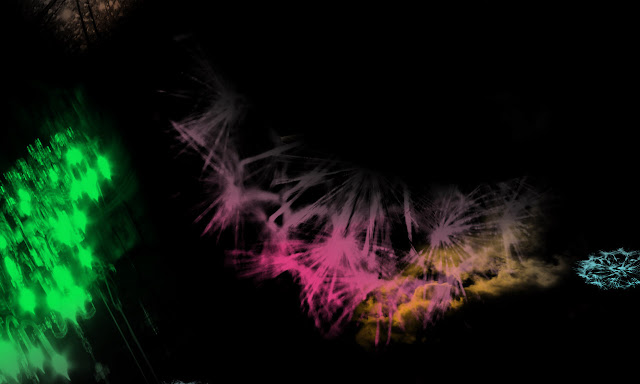
end the evolved ones: (i really worked hard to find something fine amongst the evolved ones, there were faults in some analysis mechanisms and character definitions were apparently awful, but these are fine, i like them:)
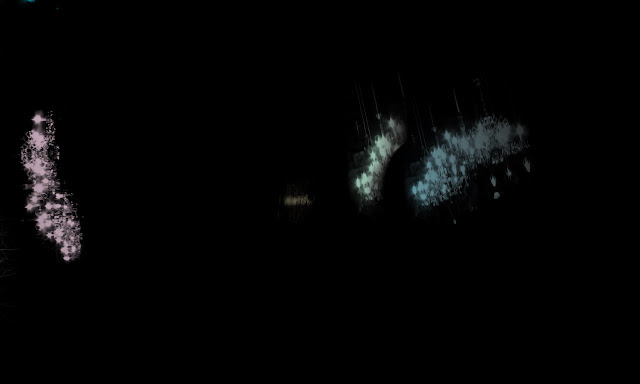
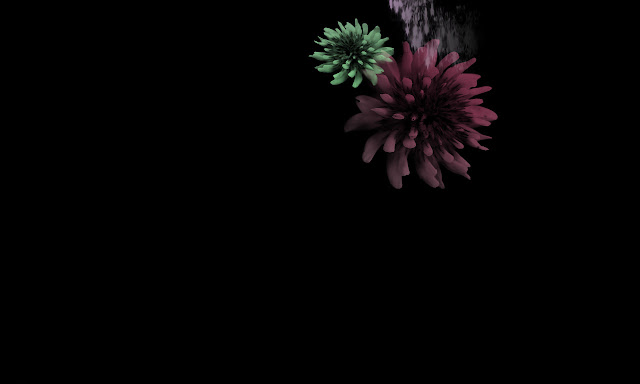
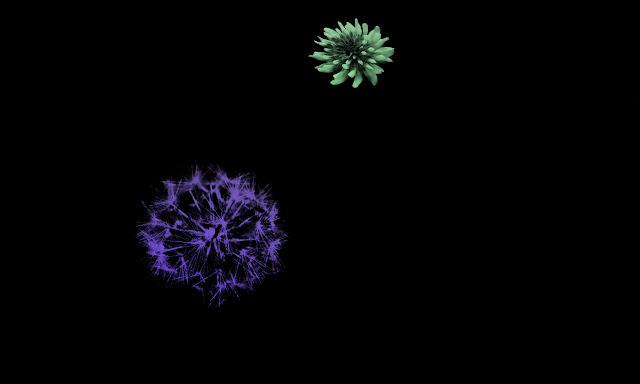

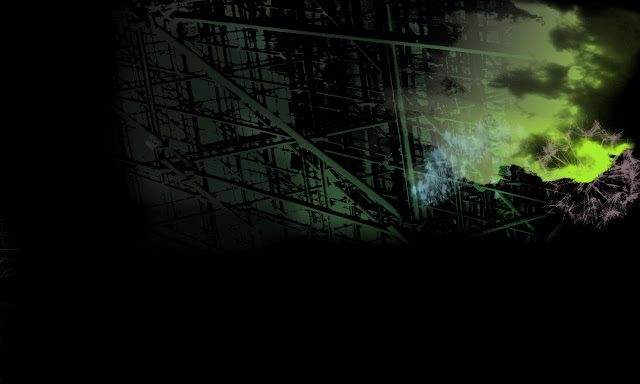
OK, enough for now. there are other stuff to come. but they will wait for a bit. i have to have some break, and do other stuff, like blogging.
a tool is one of the four atomic elements of design games system (or also framework). another one is the character. tools do, charcters direct. but in fact the separation is far than clear cut. all the atoms, ultimately, are meant to be interchangeable. so that, from the very beginning, a clear cut separation is neither possible, nor desired. and there are also objects, or individuals, in evolutionary terms. they are the alternative products, or designs that are worked on.
and? the games. a game is a compound [come on what kind of atom is it!?] but it could also be interchangeable with the others [possibly self referential?], let's calm down, right now all atoms are discrete and they are not implemented as interchangeable. a game is formed when a character directs a tool and an action is performed on an object.
and these things are produced, the following are also almost random products of the first runs to obtain a desktop icon for design games itself, but i sincerely don't remember which ones were last generation (i.e: evolved, designed) and which are byproducts of the process:


after a thousand runs i started to identify the defects of the system (it's a continuous refining and re-doing process) and then i conducted another series of runs with better character definitions and larger resolution, following are the designs of design games for itself:


the bright colors are not surprising, our character loved them, and it wanted several color areas and it got them. utilized tools were, pattern stamp, gradient, color area and text (i.e. all of them) so we moved on to another task, producing (or designing if you like) a desktop wallpaper for my laptop. again we started with very low resolution trials, these are collected amongst the byproducts, meaning that the poor evaluation capabilities of the systems or coded likings of the characters (by me) prevented their identification as 'fine':

if you didn't notice the images that were produced on previous runs were fed as patterns into these new runs, and only tool was the pattern stamp. and following are the designed ones, look at the differences between these two sets (you can only see it if you go to their pages):
so we went on and on for nights, i was sleeping and design games was working, as appropriate. check the following, they are collected from the garbage of the final runs for a high-resolution desktop wallpaper, different high resolution patterns are added to the system, and that's all:
end the evolved ones: (i really worked hard to find something fine amongst the evolved ones, there were faults in some analysis mechanisms and character definitions were apparently awful, but these are fine, i like them:)
OK, enough for now. there are other stuff to come. but they will wait for a bit. i have to have some break, and do other stuff, like blogging.
here comes the "design games" | here i am
ok, now we have another paper, no we don't have that paper, we just submitted a paper for another conference. but at least i'm glad that the researcher came to a point to start expressing its project and how it is related with all the blabla about design, games, and all the other things that the researcher had been writing and writing around this bilog. so let's start with a short explanation, i'm abstracting from my paper:
>>“design games” is a framework for a semi-automated design system which uses an evolutionary computation approach as its 'engine'. the ultimate aim of this study is developing an automated system which could take part in several design 'sub-tasks', in a collaborative environment, serving as a team of customizable virtual designers. a computer program is being developed to test and improve the approach. the system that is developed is based on a flexible, open scheme that enables us to tackle sub-tasks pertaining to different design areas, which are chosen amongst the rather ill-defined and wickedly arbitrary ones.
the system is being tested on several graphic design and illustration tasks. currently design games do not have tools developed enough for conducting a full-fledged design process solely on itself, but it manages to cooperate with the researcher and develops itself as a pupil.
[in this entry i will not be writing about the conceptual framework, 'cause they are written here, and i wrote an entry about that here.. and.. i would be glad if you have a look at that, 'cause together with what i will describe in this and next entries, it's quite more meaningful now... and... i will not explain what evolutionary computation is, but you can find something short here]
>>versatility of evolutionary computing:
_evolutionary computation approaches have already been tested in a diverse array of problem solving areas and this diverse array, no doubt, includes several design and art fields as well. this apparent versatility of evolutionary computation as an approach, and its adaptability into very different types of problem solving areas and artistic fields, is one of the reasons why we [the researcher :] utilized this approach in our study. we conceive each design process as fragmented, including a diverse array of different types of actions. hence, a corresponding system tackling a similar design process should be versatile and should be able to run a diverse array of tools pertaining to each different type of sub-tasks. we envisage evolutionary computation practically as the central engine for our system with its basic alternatives-producing (generate) and selection (test) structure.
>>form generation in evolutionary systems
_form generation is one 'vagabond' realm. in a way all design is form generation[!?] but, relationships between aims, reasonings, functionalities and forms are not always well-known; at least when it comes to creative design areas like, graphic design, architecture, interior design, fashion design or product design etc.
_it should be so formidable an area or perhaps, on the contrary so uninteresting a research field that, when it comes to form generation, most of the times, researchers either tended to convert form generation process into a better defined search (by simplifiying it of course), or, following the precedent of "the blind watchmaker" [of richard dawkins] they preferred implementing interactive evolutionary systems, where the alternatives are evaluated by human evaluators. however, interactive evaluation process is time consuming and tiresome (and in a way, it is putting the burden back again on humans).
>> “other performances” and an evolutionary proposal
_"in this study, we chose to start with tackling those irremediably 'wicked-problems', and without trying to reduce or define them in terms of explicit criteria or corresponding rational performances. the phrase “other performances” denotes those aspects or criteria, which we usually cannot 'account for' in explicit or rational terms, but we utilize heavily when we're designing. these are our heuristics, likings, beliefs, prejudices, irrationalities, principles, vagaries, and simply everything that comes handy at the moment. what we (un)define as other performances are generally not researched extensively or seen as resistant to definition. (however, that we started with them doesn't mean that we thought they were enough to define any complicated design process. our supposition is, that, in any complicated design process, different types of design acts are incorporated, and this pertains to different levels of 'definedness' as well.)"
_in order to embody this conception of the other performances, we are substituting "virtual designer characters" in place of human decision makers. they collect and imply humane vagaries heuristics, tastes etc.
_another important factor is 'restricted randomness'. the idea here is, if you don't know the reasoning behind a principle, and if it seems to yield somehow random results then it might have a genuinely random portion and the way to 'imitate' it might be randomness.
_in spite of all the emphasis on noise and randomness, design games is essentially a knowledge intensive system. knowledge is incorporated by means of tools, characters and patterns and if design games will ever be a real designing system it should learn much more than what it currently knows.
[what design games currently doing will be on the next post, for the ones who are really interested, just have a look at these works: ]
bentley, p.j. and corne, d.w. (eds): creative evolutionary systems. academic press, london. (2002)
bentley, p.j. (ed): evolutionary design by computers. morgan kaufmann publishers, san francisco (1999)
caldas, l.g.: generation of energy-efficient architecture solutions applying gene_arch: an evolution-based generative design system. advanced engineering informatics archive volume 22 , issue 1 (2008)
bitterman, m.: intelligent design objects. phd dissertation, technical university delft (2009)
hong, l., mingxi, t.: evolutionary design in a multi-agent design environment. applied soft computing 6 pp207–220 (2006)
janssen, p.h.t.: a design method and computational architecture for generating and evolving building designs. phd dissertation, hong kong polytechnic university (2004)
xiyu, l., mingxi, t., frazer, j.: an eco-conscious housing design model based on co-evolution. advances in engineering software 36 pp115–125 (2005)
banerjee, a., quiroz, j., louis, s.: a model of creative design using collaborative interactive genetic algorithms. in: gero j., goel, a. (eds.): design computing and cognition '08, pp397-416 springer science + business media b.v. (2008)
nishino, h., sueyoshi, t., kagawa,t., utsumiya, k.: an interactive 3d graphics modeler based on simulated human immune system. journal of multimedia, vol. 3, no. 3, july 2008 (2008)
marin, p., bignon, j., lequay, h.: integral evolutionary design, integrated to early stage of architectural design process generative exploration of architectural envelope responding to solar passive qualities
>>“design games” is a framework for a semi-automated design system which uses an evolutionary computation approach as its 'engine'. the ultimate aim of this study is developing an automated system which could take part in several design 'sub-tasks', in a collaborative environment, serving as a team of customizable virtual designers. a computer program is being developed to test and improve the approach. the system that is developed is based on a flexible, open scheme that enables us to tackle sub-tasks pertaining to different design areas, which are chosen amongst the rather ill-defined and wickedly arbitrary ones.
the system is being tested on several graphic design and illustration tasks. currently design games do not have tools developed enough for conducting a full-fledged design process solely on itself, but it manages to cooperate with the researcher and develops itself as a pupil.
[in this entry i will not be writing about the conceptual framework, 'cause they are written here, and i wrote an entry about that here.. and.. i would be glad if you have a look at that, 'cause together with what i will describe in this and next entries, it's quite more meaningful now... and... i will not explain what evolutionary computation is, but you can find something short here]
>>versatility of evolutionary computing:
_evolutionary computation approaches have already been tested in a diverse array of problem solving areas and this diverse array, no doubt, includes several design and art fields as well. this apparent versatility of evolutionary computation as an approach, and its adaptability into very different types of problem solving areas and artistic fields, is one of the reasons why we [the researcher :] utilized this approach in our study. we conceive each design process as fragmented, including a diverse array of different types of actions. hence, a corresponding system tackling a similar design process should be versatile and should be able to run a diverse array of tools pertaining to each different type of sub-tasks. we envisage evolutionary computation practically as the central engine for our system with its basic alternatives-producing (generate) and selection (test) structure.
>>form generation in evolutionary systems
_form generation is one 'vagabond' realm. in a way all design is form generation[!?] but, relationships between aims, reasonings, functionalities and forms are not always well-known; at least when it comes to creative design areas like, graphic design, architecture, interior design, fashion design or product design etc.
_it should be so formidable an area or perhaps, on the contrary so uninteresting a research field that, when it comes to form generation, most of the times, researchers either tended to convert form generation process into a better defined search (by simplifiying it of course), or, following the precedent of "the blind watchmaker" [of richard dawkins] they preferred implementing interactive evolutionary systems, where the alternatives are evaluated by human evaluators. however, interactive evaluation process is time consuming and tiresome (and in a way, it is putting the burden back again on humans).
>> “other performances” and an evolutionary proposal
_"in this study, we chose to start with tackling those irremediably 'wicked-problems', and without trying to reduce or define them in terms of explicit criteria or corresponding rational performances. the phrase “other performances” denotes those aspects or criteria, which we usually cannot 'account for' in explicit or rational terms, but we utilize heavily when we're designing. these are our heuristics, likings, beliefs, prejudices, irrationalities, principles, vagaries, and simply everything that comes handy at the moment. what we (un)define as other performances are generally not researched extensively or seen as resistant to definition. (however, that we started with them doesn't mean that we thought they were enough to define any complicated design process. our supposition is, that, in any complicated design process, different types of design acts are incorporated, and this pertains to different levels of 'definedness' as well.)"
_in order to embody this conception of the other performances, we are substituting "virtual designer characters" in place of human decision makers. they collect and imply humane vagaries heuristics, tastes etc.
_another important factor is 'restricted randomness'. the idea here is, if you don't know the reasoning behind a principle, and if it seems to yield somehow random results then it might have a genuinely random portion and the way to 'imitate' it might be randomness.
_in spite of all the emphasis on noise and randomness, design games is essentially a knowledge intensive system. knowledge is incorporated by means of tools, characters and patterns and if design games will ever be a real designing system it should learn much more than what it currently knows.
[what design games currently doing will be on the next post, for the ones who are really interested, just have a look at these works: ]
bentley, p.j. and corne, d.w. (eds): creative evolutionary systems. academic press, london. (2002)
bentley, p.j. (ed): evolutionary design by computers. morgan kaufmann publishers, san francisco (1999)
caldas, l.g.: generation of energy-efficient architecture solutions applying gene_arch: an evolution-based generative design system. advanced engineering informatics archive volume 22 , issue 1 (2008)
bitterman, m.: intelligent design objects. phd dissertation, technical university delft (2009)
hong, l., mingxi, t.: evolutionary design in a multi-agent design environment. applied soft computing 6 pp207–220 (2006)
janssen, p.h.t.: a design method and computational architecture for generating and evolving building designs. phd dissertation, hong kong polytechnic university (2004)
xiyu, l., mingxi, t., frazer, j.: an eco-conscious housing design model based on co-evolution. advances in engineering software 36 pp115–125 (2005)
banerjee, a., quiroz, j., louis, s.: a model of creative design using collaborative interactive genetic algorithms. in: gero j., goel, a. (eds.): design computing and cognition '08, pp397-416 springer science + business media b.v. (2008)
nishino, h., sueyoshi, t., kagawa,t., utsumiya, k.: an interactive 3d graphics modeler based on simulated human immune system. journal of multimedia, vol. 3, no. 3, july 2008 (2008)
marin, p., bignon, j., lequay, h.: integral evolutionary design, integrated to early stage of architectural design process generative exploration of architectural envelope responding to solar passive qualities
30 Eylül 2009 Çarşamba
from our eCAADe presentation:
[the story was something like this:]
1. motive:
_to build a design model
_to produce a design system
> starting with the complex, which is due response to design problems which almost always involve multiple tasks, different agents and unique problem constructing and solving processes.
> a multi-agent approach, incorporating human and non-human processes
2. assumption I:

[note: It is not our aim to define the sphere of design as a kind of language that has its syntax and grammar, or to define it with an implicit structure, or as a system of hierarchies. On the contrary, we are aiming to re-define this sphere without definite hierarchies, pre-defined structures, or systems. Therefore we use the concept of ‘family resemblances’, following Wittgenstein, in a similar vein yet differently, as indicating a possibility of a communication or collaboration between different kinds of design games. In addition, we also intend to address relations/interactions between agents that are defined together with the games that they play. There is ambiguity, uncertainty, and overlapping as well as incongruities on the borders that are _at best, artificially_ formed between the design games.]
3. about design games:
_Design games do not constitute a definite system. Rather, they are dispersed inside an infinite design universe.
_Reconstituting ‘stored’ design games is a standard behavior of the human designer (such as, a specific exploration by sketching, a singular process of creation via modeling, a study of detailing via producing scaled drawings...)
_When design activity is defined as an ever-changing universe, which has a place for every act, whether important or not, without any pre-determined hierarchy, design process can be redefined in a rather unrestricted way.
_If design, rather than being conceived as a unified act, is considered as constantly being produced by an infinite number of diversified, singular design games, then, design procedures may be freed of being conceived as inseparable parts -as absolutely stable entities- pertaining to definite stages of design, while potentialities of hitherto unnoticed acts in the process might be discovered; if not created anew. This understanding does not correspond to a state where the multi-layered progression of design process from preliminary to detailed is neglected.
_When we define design process with blurry components and indefinite stages (as with ‘free-floating’ design games), we can model design as a complex, collaborative process, where the designers’ (agents’) biological states lose importance. This means, an agent may be a person, a machine, a program, a tool, or a natural process like wind, or flood.
_This approach, may give rise to a better conception, in terms of contemporary realm of design, where human-human, human-machine, machine-machine, or process -process interactions, thus a framework of collaboration might be better defined.
4. assumption II > Creative automation:
If we start from this conception to produce a design framework, even though at the expense of major simplifications, we may obtain a model for design automation studies. First, defining a better cooperation between humans and machines may gradually give way to more ‘clever’ design tools. But there is another potential of this model: the above defined loose pattern of design games, when combined with the possibility of all the agents’ being non-humans, seems to indicate the road to ‘creative design automation’.
5. simplified and more simplified models:
[trying to emphasize the fictitious quality of understanding and model constructing:]

1. design game: the elusive basic unit of a design process (amorphous closed areas on the left, regular closed boxes on the right)
2. agent: human, wind, computer, dna... (some of the unique signs on the left, a1, a2, ai on the right)
3. tool: hammer, eye, human, computer application... (some of the unique signs on the left, t1, t2, ti on the right)
4. object: model, drawing, human, evolutionary algorithm... (on the left all is the objective flow, on the right the thin trajectories are the objects being transformed)
6. assumption III
Evolutionary strategies:
Evolution is a pertinent strategy for problem solving in this universe, so are evolutionary computation approaches.
[a story for this universe: A ‘design game’ has a becoming that involves its relationship to other design games situated on the same plane. Here design games link up with each other, support one another, coordinate their contours, articulate their respective problems, and belong to the same design process, even if they have different histories. In fact, having an infinite number of components, every design game will branch off toward other design games that are differently composed but that constitute other regions of the same plane, answer to problems that can be connected to each other, and participate in a co-creation. A design game requires not only a problem through which it recasts or replaces earlier design games but a junction of problems where it combines with other coexisting design games. (“Détournement” from Deleuze and Guattari, 1999, p18)
Design games, which have only consistency outside of any definite coordinates, freely enter into relationships of resonance, either because the components of one become ingredients of other heterogeneous components or because there is little difference of scale between them at some levels. Design games are centers of vibrations, each in itself and every one in relation to all the others. This is why they all resonate rather than cohere or correspond with each other. There is no reason why design games should cohere. As fragmentary totalities, design games are not even the pieces of a puzzle, for their irregular contours do not correspond to each other. They do form a wall, but it is a dry-stone wall, and everything is held together only along diverging lines. Even bridges from one design game to another are still junctions, or detours, which do not define any systematic whole. They are movable bridges. From this point of view, design can be seen as being in a perpetual state of digression or digressiveness. (Détournement from Deleuze and Guattari 1999, p23)]
7. fiction 1: given infinite computational power and time >
[think about the hierarchy of levels.. system 1 is a basic evolutionary strategy based on "genetic algorithms", but when you just abolish the semantic and functional borders of the items, then you can insert any item as any semantic-functional type (in this fiction we have only one item type!). items are competing to deliver their characteristics to posterior generations. but any evolutionary strategy might be a competing item itself, so it goes, if you have enough time, computing power, and credulity?]

8. fiction 2: given infinite computational power and time >
[here we have a rather more 'structured' fiction. now we have 4 functional types. items are accepted as interchangeable, this means, any item might be inserted with any of the four roles, and try as many alternatives as you can, because only a small fraction of the trials will result in meaningful solutions, and most of them will be the expected results (tautologiacl in a sense)]

9. considerations:
>>what to gain: if fed with more knowledge [give more weight to the choices and methods that are known to be effective], and conducted in a more ‘directed’ manner [do not behave as if you have no goal -like in natural evolution- but implement a goal oriented system and revise it continously], not only desired products but also primitive compounds and techniques could be obtained in a creative manner.
>>drawbacks: excessive computation, time and energy are needed to achieve these goals, and given the desired vagueness of the evolutionary structure, success is not guaranteed. [but you cannot give away the vagueness, this is what you have to keep in your system if you're dealing with architectural design]
>>to make it work:
_more (expert) human agents and intervention [start with less automized systems]
_more knowledge: human skill/knowledge + knowledge loaded tools [don't move randomly but search for several goals with the available knowledge]
_simpler systems with knowledge overload [start as simple as possible]

10. two imaginary projects:
atomic>>
_a number of atomic parameter sets as items
_a simple common-language for communication between items and administrator
_several predefined "proven techniques and strategies" (kör gözüm parmağına.. test için)
_let the system search for and learn useful techniques
semantic>>
_a number of atomic parameter sets but based on some imaginary or actual methods (how will you represent them to the system and with which language structure, a case-based semantic layer tool? a constraint based "gabari" tool? a rulebased law interpreter? a constraint based generative floor layout design tool? a virtual floor layout designer agent that can use it?...)
_a simple common-language for communication between items and administrator (use xml for it?)
_several expectations for effective techniques and strategies"
_let the system search for and learn useful techniques (but the main goal is to establish the language and communicative structure and try to define the role for possible semantic layers)
1. motive:
_to build a design model
_to produce a design system
> starting with the complex, which is due response to design problems which almost always involve multiple tasks, different agents and unique problem constructing and solving processes.
> a multi-agent approach, incorporating human and non-human processes
2. assumption I:
[note: It is not our aim to define the sphere of design as a kind of language that has its syntax and grammar, or to define it with an implicit structure, or as a system of hierarchies. On the contrary, we are aiming to re-define this sphere without definite hierarchies, pre-defined structures, or systems. Therefore we use the concept of ‘family resemblances’, following Wittgenstein, in a similar vein yet differently, as indicating a possibility of a communication or collaboration between different kinds of design games. In addition, we also intend to address relations/interactions between agents that are defined together with the games that they play. There is ambiguity, uncertainty, and overlapping as well as incongruities on the borders that are _at best, artificially_ formed between the design games.]
3. about design games:
_Design games do not constitute a definite system. Rather, they are dispersed inside an infinite design universe.
_Reconstituting ‘stored’ design games is a standard behavior of the human designer (such as, a specific exploration by sketching, a singular process of creation via modeling, a study of detailing via producing scaled drawings...)
_When design activity is defined as an ever-changing universe, which has a place for every act, whether important or not, without any pre-determined hierarchy, design process can be redefined in a rather unrestricted way.
_If design, rather than being conceived as a unified act, is considered as constantly being produced by an infinite number of diversified, singular design games, then, design procedures may be freed of being conceived as inseparable parts -as absolutely stable entities- pertaining to definite stages of design, while potentialities of hitherto unnoticed acts in the process might be discovered; if not created anew. This understanding does not correspond to a state where the multi-layered progression of design process from preliminary to detailed is neglected.
_When we define design process with blurry components and indefinite stages (as with ‘free-floating’ design games), we can model design as a complex, collaborative process, where the designers’ (agents’) biological states lose importance. This means, an agent may be a person, a machine, a program, a tool, or a natural process like wind, or flood.
_This approach, may give rise to a better conception, in terms of contemporary realm of design, where human-human, human-machine, machine-machine, or process -process interactions, thus a framework of collaboration might be better defined.
4. assumption II > Creative automation:
If we start from this conception to produce a design framework, even though at the expense of major simplifications, we may obtain a model for design automation studies. First, defining a better cooperation between humans and machines may gradually give way to more ‘clever’ design tools. But there is another potential of this model: the above defined loose pattern of design games, when combined with the possibility of all the agents’ being non-humans, seems to indicate the road to ‘creative design automation’.
5. simplified and more simplified models:
[trying to emphasize the fictitious quality of understanding and model constructing:]
1. design game: the elusive basic unit of a design process (amorphous closed areas on the left, regular closed boxes on the right)
2. agent: human, wind, computer, dna... (some of the unique signs on the left, a1, a2, ai on the right)
3. tool: hammer, eye, human, computer application... (some of the unique signs on the left, t1, t2, ti on the right)
4. object: model, drawing, human, evolutionary algorithm... (on the left all is the objective flow, on the right the thin trajectories are the objects being transformed)
6. assumption III
Evolutionary strategies:
Evolution is a pertinent strategy for problem solving in this universe, so are evolutionary computation approaches.
[a story for this universe: A ‘design game’ has a becoming that involves its relationship to other design games situated on the same plane. Here design games link up with each other, support one another, coordinate their contours, articulate their respective problems, and belong to the same design process, even if they have different histories. In fact, having an infinite number of components, every design game will branch off toward other design games that are differently composed but that constitute other regions of the same plane, answer to problems that can be connected to each other, and participate in a co-creation. A design game requires not only a problem through which it recasts or replaces earlier design games but a junction of problems where it combines with other coexisting design games. (“Détournement” from Deleuze and Guattari, 1999, p18)
Design games, which have only consistency outside of any definite coordinates, freely enter into relationships of resonance, either because the components of one become ingredients of other heterogeneous components or because there is little difference of scale between them at some levels. Design games are centers of vibrations, each in itself and every one in relation to all the others. This is why they all resonate rather than cohere or correspond with each other. There is no reason why design games should cohere. As fragmentary totalities, design games are not even the pieces of a puzzle, for their irregular contours do not correspond to each other. They do form a wall, but it is a dry-stone wall, and everything is held together only along diverging lines. Even bridges from one design game to another are still junctions, or detours, which do not define any systematic whole. They are movable bridges. From this point of view, design can be seen as being in a perpetual state of digression or digressiveness. (Détournement from Deleuze and Guattari 1999, p23)]
7. fiction 1: given infinite computational power and time >
[think about the hierarchy of levels.. system 1 is a basic evolutionary strategy based on "genetic algorithms", but when you just abolish the semantic and functional borders of the items, then you can insert any item as any semantic-functional type (in this fiction we have only one item type!). items are competing to deliver their characteristics to posterior generations. but any evolutionary strategy might be a competing item itself, so it goes, if you have enough time, computing power, and credulity?]
8. fiction 2: given infinite computational power and time >
[here we have a rather more 'structured' fiction. now we have 4 functional types. items are accepted as interchangeable, this means, any item might be inserted with any of the four roles, and try as many alternatives as you can, because only a small fraction of the trials will result in meaningful solutions, and most of them will be the expected results (tautologiacl in a sense)]
9. considerations:
>>what to gain: if fed with more knowledge [give more weight to the choices and methods that are known to be effective], and conducted in a more ‘directed’ manner [do not behave as if you have no goal -like in natural evolution- but implement a goal oriented system and revise it continously], not only desired products but also primitive compounds and techniques could be obtained in a creative manner.
>>drawbacks: excessive computation, time and energy are needed to achieve these goals, and given the desired vagueness of the evolutionary structure, success is not guaranteed. [but you cannot give away the vagueness, this is what you have to keep in your system if you're dealing with architectural design]
>>to make it work:
_more (expert) human agents and intervention [start with less automized systems]
_more knowledge: human skill/knowledge + knowledge loaded tools [don't move randomly but search for several goals with the available knowledge]
_simpler systems with knowledge overload [start as simple as possible]
10. two imaginary projects:
atomic>>
_a number of atomic parameter sets as items
_a simple common-language for communication between items and administrator
_several predefined "proven techniques and strategies" (kör gözüm parmağına.. test için)
_let the system search for and learn useful techniques
semantic>>
_a number of atomic parameter sets but based on some imaginary or actual methods (how will you represent them to the system and with which language structure, a case-based semantic layer tool? a constraint based "gabari" tool? a rulebased law interpreter? a constraint based generative floor layout design tool? a virtual floor layout designer agent that can use it?...)
_a simple common-language for communication between items and administrator (use xml for it?)
_several expectations for effective techniques and strategies"
_let the system search for and learn useful techniques (but the main goal is to establish the language and communicative structure and try to define the role for possible semantic layers)
5 Mayıs 2009 Salı
the semi-living author: post-human creative agency
bir makale geçti elime (sevgi binyaşa). “the semi-living author: post-human creative agency”, rolf hughes*. ilginç yanları var. benim doktora konumun da bu “authorship” meselesiyle ilgisi yok değil. tasarım otomasyonu, benim konum. ve düşüncem de tasarım süreci akışında insan aktörlerin makineden aktörlere prensipte bir üstünlüğü olmadığı yönünde. bu yüzden bir “tasarım oyunları modeli” kurgulayabilir miyiz diye düşünüyorduk. bildiğimiz anlamda oyun değil de wittgenstein’in “dil oyunları”ndan ilham alan bir kavramlaştırma. tasarım sürecini, bir seri aktörün yürüttüğü (ve bir noktada tamamladığı) bir seri sözde-atomik oyun/iş üzerinden yeniden tanımlarsak, bu sadeleştirme insan-makine, insan-insan ve makine-makine ilişkisini birbirine eşdeğer biçimde içine alan kısmen-otomatik bir tasarım sistemine/yaklaşımına bizi yaklaştırabilir mi? [ve tabi bunun iki boyutu daha var: 1. tasarım oyunları üzerinden karmaşık bir tasarım modeli ile tasarımı 'anlamak' 2. ve bu kavrayış üzerinden bir mimari tasarım eğitimini yönlendirmek]
bu makalede fikri ilginç bir yönde genişletebilecek örnekler var. ilginç gelen yerleri kendi eklemelerimle aktarıyorum:
p132. “...is authorship inseparable from notions of chronology and historical sequence?” [halihazırda bulunan bir maddeyi halihazırda bulunan biçimlere koyan bir dönüştürücü demiurge ile islamdakine benzer bir yoktan vareden yaratıcı tanrıyı karşıtlık içine koyuyor. (timaeus_platon vs. itiraflar_augustinus.)] “as late arrivals they [architects, artists and authors] can play the role neither of pagan prime mover nor of christian innovator ... but must rather begin with what has already been created and thereby accept historical traditions...” [her tasarım aktörü akagelmekte olan tikel ama dağınık bir tasarım sürecinin farklı aşamalarına eklenegelir, bu aktörlerin makine ya da insan olmasının prensipte bir önemi yoktur.]
“agency is a central concern in recent creative practices that exhibit a turn from analysing nature to its synthesis. these include algorithmic, generative or ‘evolutionary’ design, bioart and metacreation...” [bunlar benim doktora çalışma alanlarım] “at one extreme, an ‘author’ would appear to have no role as such in work designed to make itself, thereby exhibiting the principle of autopoiesis or “self-making”. an autopoetic system produces not only self-sustaining patterns, but also, more significantly, its own components, the components that produce in turn the system’s organisation.” [bizim evirip çevirdiğimiz sistem daha büyük bir kurgunun bir bileşeni. bütünlüğünde kimin ‘müellif’ olduğunu önemsizleştiren bir aktörler dağılımı var. ama kafamdaki öykücü de tam böyle bir aktör. insanı öykücü olarak, tasarımcıyı öykücü olarak kurgulamak zaten bir öykülenme sürecine katılmak kavrayışına hakkını veriyor. müelliflik zaten, bugün, büyük ölçüde altıboşalmış bir kurum?: hem güncel felsefi yaklaşımlar (benim yaklaşımım için de), hem ticari süreçler (büyük şirketler dünyası ve akademide yoğun işbirliği ve işbölümü, dağıtım alanında korsan, internet üzerinden paylaşım...), hem sanat-edebiyat alanında 20.yydan devralınan kopyalama, kolajlama, çalıntılama gelenekleri, ayrılmış bir uzman olarak sanatçıya karşı çıkışın alman romantiklerden beri süregelen ve ‘meta-üretimi olarak sanat pratiğine karşı çıkmak’ ve ‘deneyim olarak sanat’ı ön plana çıkarmaklara varan geçmişi...]
p133. “...by examining these two poles of contemporary authorship –[1] autopoietic authorial erasure on the one side, and [2] technoscience’s seemingly unbounded pursuit of mastery over living matter, on the other- i will explore the continuing centrality of authorship...”
julie thompson klein’den naklediyor: “today’s many disciplinary convergences have contributed ... toreversing “the differentiating, classificatory dynamic of modernity” and creating instead an “increasing hybridisation of cultural categories, identities, and previous certainties”. this means that there exists agrowing number of professional issues that cannot be tackled with the tools avaliable within existing forms of discilinary practice. “many of the problems professionals face are neither predictable nor simple” ... “they are unique and complex ... as a result, the art of being a professional is becoming the art of managing complexity” [şimdi bunları julie t. k. diye bir hanımdan, ya da lawson diye bir beyden nakletsem muteber olacağım, kendim söylediğimde muteber olmuyor, bu kenarda kalmış ülke akademik dünyası ruh-durumu ne fena] [neyse sonra da gerektiği şekilde farklı disiplinleri, neuro-science araştırmalarını sanat, performans ve yapay hayat araştırmalarıyla biraraya getiren ilk örneğinden bahsetmeye geçiyor:]
MEART: “the semi-living artist”: a geographically detached, wetware/software/hardeware hybrid, which comprises both living and artificial components. (Philip Gamblen ve Guy Ben-Ary of SymbioticA art and science collaborative research lab at the university of western australia)
p134. “the artist’s ‘brain’ (neurons from mouse cortex grown over a “multi electrode array”) is nurtured in dr steve potter’s neuro-engineering lab at georgia institute of technology, atlanta; it’s ‘body’ (a robotic drawing arm capable of executing two dimensional drawings) is set up at the location of each exhibition (... linz, perth, new york, bilbao, moscow, melbourne, atlanta, shangai). the geographical remoteness of the ‘wetware’ and ‘hardware’ is surmounted by two software modules: one in atlanta and one at the location of each exhibition with the internet operating as a form of ‘nervous system’ to interface between brain and body. as the MEART has developed, it has begun to explore the cognitive dimensions of ‘seeing’ and converting what it ‘sees’ into representation. thus the robotic arm can send an image from a digital camera, which is converted as it arrives at the brain into a thumbnail of 60 pixels, each correlating to 60 electrodes that then stimulate the neurons grown on an electronic chip. this image is then compared with what the robotic arm has already drawn on the paper (spaces that are dark in the photo and blank on the paper are identified as areas to correct, for example); the neurons process this information, the electric signals on the electrodes are measured again and this measurement becomes the basis for guiding the robotic arm. the digital camera records what the arm ‘draws’ and sends a signal back to the neurons, which is evaluated as before and further modifications are sent back to the arm. thus the optical element (the digital camera) monitors the progress of the drawing. the result of this activity is then converted into a stimulation map that is sent to the neurons. these stimulations inform the neurons about the state of the drawing. ...”
[insan fackdıri’yi hatırlıyor, aslında yukarıdan beri öykülenegelenlerin eğlenceli bir parodiler serisi ile üretime dönmesi olabilirdi. ]
“MEART is an example of how an interdisciplinary team, exploring the conceptual space where scientific and cultural experiments converge, can generate compelling subject-specific research questions alongside resonant metaphors of broader philosophical significance.” [ve insan umut doluyor tabi, benim de bir yerim olabilir, diyelim ki yapay zeka araştırmalarında, hı?]
p135. “... (characteristic of a-life artists more generally) equate creativity with unpredictability; what is valued is the artefact’s escape from authorial intention (and robotic predictability) towards emergent excess and autonomy.” [bağlamından koparıp aldım bunu, ilginç bir konu ve benim çalışmam kapsamında uğraşmam gereken bir mesele]
p136. “like other information artists, MEART’s artistic emphasis is on process, practice and skill, an emphasis shared by practice-based research [bu tabirin hastasıyım, doktoramla ilgili her yere yazmak istiyorum]. Yet whereas practice-based research in art and design privileges experiential knowledge (including its epistemic siblings ‘embodied’, ‘situtated’, ‘practical’, or ‘tacit’ knowledge), the work of information artists is frequently characterised by a concern with disembodiment, which we may define as “the technologically driven unmooring of human cognition”. [burada sorun görmek için olagelmekten başka türlü bir değişmez/kalıcı varlık hayal ediyor olmak lazım. beden de olagelmektedir, zihinsel süreçler de. bir tür/töz farkından ziyade deleuzecül bir tekseslilikten(?) hareket edersek disembodiment ve embodied arasında bir ayrım görmeyiz. practice-based dendiğinde benim aklıma bir maddi bedene gömülmüş/katılmış bir bilgiden ziyade bir görece kontollü deneyim artırma süreci geliyor... ?? ne acayip pasaj oldu...] “to mimic living matter, however, is not the same as creating a compelling parallel for human experience in creative practices. design-based experience (and, importantly, its communication) is arguably what nourishes the processes and outcomes of the creative disciplines – it is surely what distinguishes creative processes from those that are merely mechanical.” [bana bu da önemli bir noktayı hatırlatıyor, şimdilik terminolojiyi oturtamadımsa/öğrenemedimse de ben burada bir doubling-emulation ayrımın gitmeye çalışıyorum. otomasyon araştırmasının hedefi birebir insan tasarımcının yaşadığı süreci yeniden üretmek değil, tasarım sürecinin çeşitli aşamaları için kabul edilebilir ürünler üretmek. burada insan tasarımcının çalışma tarzından ilham alınması üretilecek sistemin baştan aşağı onun gibi çalışacağı anlamına gelmiyor]
p137 “... software needs to be designed for which all the possibilities cannot be considered in advance by the designer. . w. ross ashby has termed this “descartes’ dictum” and noted that for a device to achieve better performance than its initial specification it would need to be informationally open and capable of interacting with the world independently of its designer- in other words, it must display characteristics of both epistemic and structural autonomy. hence perhaps the current turn from code to ‘wetware’ – a shift that may be characterised historically as a displacement of modernism’s use of technology to control nature by postmodernism’s use of living matter (‘nature’) to ‘enliven’ technology, to escape its monotonous and repetitive logic and pursue instead the unpredictable, ‘emergent’ and creative capacities of a meeting between organic, mechanical, and electronic impulses.” [bunu şimdilik süreçlere “tesadüfilik” enjekte ederek karşılamak niyetindeyim]
[ve ikinci örnek:]
p138. “dendroid, a collaboration between pablo miranda and artist arijana kajfes as part of the occular witness project, comprises an electrochemical bath, a microcontroller circuit and software running on a standard computer. in this electrochemical hardware the system does the typical transformations involved in projective geometry and characteristic of CAD programs, such as rotation, scaling, and all the different types of parallel and perspective projections. in dendroid geometric data in the form of three dimensional vectors (x,y,z) is translated into electric signals which pass through the dendrites in the electrolytic bath, are then read, and subsequently translated again into geometric information. signal transformations are equated to geometrical transformations. as with an apprentice architect, the device can be trained (if given a set of geometric transformations such as those corresponding to architectural drawings, it can be ‘indoctrinated’ to produce the standard, average architectural projective transformation) or –again like its human counterpart- it can be left to grow arbitrarily, without learning. in the latter case, after a period of formation and growth, the device is capable of geometrical transformations and becomes effectively “a serendipitous machine, suggesting different 3-D transformations according to the growth patterns of the dendritic machine.”
p140. “... whitelaw observes, a-life art becomes a “metacreative” endeavour –“it wants to create creation, variation, otherness. if a-life science is about knowing and understanding, a-life art is very basically about making and becoming, becoming-other, and becoming-unknown.” ”
[yine klein diyor ki:]
“the complexity of knowledge is suggested by the current rhetoric of description. once described as a foundation or linear structure, knowledge today is depicted as a network or a web with multiple nodes of connection, and a dynamic system. the metaphor of unity, with its accompanying values of universality and certainty, has been replaced by metaphors of plurality relationality in a complex world. images of boundary crossing and cross-fertilisation are superseding imagesof disciplinary depth and compartmentalization. isolated modes of work are being supplanted by affiliations, coalitions and alliances. and older values of control, mastery, and expertise are being reformulated as dialogue, interaction and negotiation. changes in the spatial and temporal structures of knowledge also call into question traditional images of knowledge as a cognitive map with distinct territories and borders or a tree with different branches. they are too linear. in their place, images of fractals, a kaleidoscope, or a wildly growing rhizome without a central root have been proposed.”
[ve film yönetmenliği pratiğini hatırlattıktan sonra:]
p141. “within such a collaborative mode of cultural production, the specific creative, expressive and artistic input of the various agencies working together on a project (and their individual contributions to the project’s ‘style’) can thereby be analysed, alongside “the socio-cultural practices of contemporary media culture which constructs the auteur as a commodity, a logo so to speak, which stands not behind the text as in romantic notions of authorship, but rather in front of it precisely to explicate, expand and legitimise the marks of individuality, expression and style in a film.” ” [paul watson’dan] [ mimarlık alanında paralel güncel süreçlerle ilgili bir ahkam için bkz. sabahları niye mimarlığın bu kadar güzel yıldız haritalarını yapıyoruz]
* Hughes, Rolf; The Semi-Living Author: Post-Human Creative Agency; in Architecture and Authorship; Anstey, T., Grillner, K., Hughes, R.; black dog publishing, 2007, pp132-141
ayrıca kaynakçada ilginç duran metinleri not ediyorum:
_hayles, n. katherine; how we became posthuman; university of chicago, london, 1999
_klein, julie thompson; interdisciplinarity and complexity: an evolving relationship; in E:CO special double issue, vol.6, nos. 1-2, 2004
_rosenberg, martin e.; constructing autopoiesis: the architectural body in light of contemporary cognitive science, in interfaces 21/22, 2003
bu makalede fikri ilginç bir yönde genişletebilecek örnekler var. ilginç gelen yerleri kendi eklemelerimle aktarıyorum:
p132. “...is authorship inseparable from notions of chronology and historical sequence?” [halihazırda bulunan bir maddeyi halihazırda bulunan biçimlere koyan bir dönüştürücü demiurge ile islamdakine benzer bir yoktan vareden yaratıcı tanrıyı karşıtlık içine koyuyor. (timaeus_platon vs. itiraflar_augustinus.)] “as late arrivals they [architects, artists and authors] can play the role neither of pagan prime mover nor of christian innovator ... but must rather begin with what has already been created and thereby accept historical traditions...” [her tasarım aktörü akagelmekte olan tikel ama dağınık bir tasarım sürecinin farklı aşamalarına eklenegelir, bu aktörlerin makine ya da insan olmasının prensipte bir önemi yoktur.]
“agency is a central concern in recent creative practices that exhibit a turn from analysing nature to its synthesis. these include algorithmic, generative or ‘evolutionary’ design, bioart and metacreation...” [bunlar benim doktora çalışma alanlarım] “at one extreme, an ‘author’ would appear to have no role as such in work designed to make itself, thereby exhibiting the principle of autopoiesis or “self-making”. an autopoetic system produces not only self-sustaining patterns, but also, more significantly, its own components, the components that produce in turn the system’s organisation.” [bizim evirip çevirdiğimiz sistem daha büyük bir kurgunun bir bileşeni. bütünlüğünde kimin ‘müellif’ olduğunu önemsizleştiren bir aktörler dağılımı var. ama kafamdaki öykücü de tam böyle bir aktör. insanı öykücü olarak, tasarımcıyı öykücü olarak kurgulamak zaten bir öykülenme sürecine katılmak kavrayışına hakkını veriyor. müelliflik zaten, bugün, büyük ölçüde altıboşalmış bir kurum?: hem güncel felsefi yaklaşımlar (benim yaklaşımım için de), hem ticari süreçler (büyük şirketler dünyası ve akademide yoğun işbirliği ve işbölümü, dağıtım alanında korsan, internet üzerinden paylaşım...), hem sanat-edebiyat alanında 20.yydan devralınan kopyalama, kolajlama, çalıntılama gelenekleri, ayrılmış bir uzman olarak sanatçıya karşı çıkışın alman romantiklerden beri süregelen ve ‘meta-üretimi olarak sanat pratiğine karşı çıkmak’ ve ‘deneyim olarak sanat’ı ön plana çıkarmaklara varan geçmişi...]
p133. “...by examining these two poles of contemporary authorship –[1] autopoietic authorial erasure on the one side, and [2] technoscience’s seemingly unbounded pursuit of mastery over living matter, on the other- i will explore the continuing centrality of authorship...”
julie thompson klein’den naklediyor: “today’s many disciplinary convergences have contributed ... toreversing “the differentiating, classificatory dynamic of modernity” and creating instead an “increasing hybridisation of cultural categories, identities, and previous certainties”. this means that there exists agrowing number of professional issues that cannot be tackled with the tools avaliable within existing forms of discilinary practice. “many of the problems professionals face are neither predictable nor simple” ... “they are unique and complex ... as a result, the art of being a professional is becoming the art of managing complexity” [şimdi bunları julie t. k. diye bir hanımdan, ya da lawson diye bir beyden nakletsem muteber olacağım, kendim söylediğimde muteber olmuyor, bu kenarda kalmış ülke akademik dünyası ruh-durumu ne fena] [neyse sonra da gerektiği şekilde farklı disiplinleri, neuro-science araştırmalarını sanat, performans ve yapay hayat araştırmalarıyla biraraya getiren ilk örneğinden bahsetmeye geçiyor:]
MEART: “the semi-living artist”: a geographically detached, wetware/software/hardeware hybrid, which comprises both living and artificial components. (Philip Gamblen ve Guy Ben-Ary of SymbioticA art and science collaborative research lab at the university of western australia)
p134. “the artist’s ‘brain’ (neurons from mouse cortex grown over a “multi electrode array”) is nurtured in dr steve potter’s neuro-engineering lab at georgia institute of technology, atlanta; it’s ‘body’ (a robotic drawing arm capable of executing two dimensional drawings) is set up at the location of each exhibition (... linz, perth, new york, bilbao, moscow, melbourne, atlanta, shangai). the geographical remoteness of the ‘wetware’ and ‘hardware’ is surmounted by two software modules: one in atlanta and one at the location of each exhibition with the internet operating as a form of ‘nervous system’ to interface between brain and body. as the MEART has developed, it has begun to explore the cognitive dimensions of ‘seeing’ and converting what it ‘sees’ into representation. thus the robotic arm can send an image from a digital camera, which is converted as it arrives at the brain into a thumbnail of 60 pixels, each correlating to 60 electrodes that then stimulate the neurons grown on an electronic chip. this image is then compared with what the robotic arm has already drawn on the paper (spaces that are dark in the photo and blank on the paper are identified as areas to correct, for example); the neurons process this information, the electric signals on the electrodes are measured again and this measurement becomes the basis for guiding the robotic arm. the digital camera records what the arm ‘draws’ and sends a signal back to the neurons, which is evaluated as before and further modifications are sent back to the arm. thus the optical element (the digital camera) monitors the progress of the drawing. the result of this activity is then converted into a stimulation map that is sent to the neurons. these stimulations inform the neurons about the state of the drawing. ...”
[insan fackdıri’yi hatırlıyor, aslında yukarıdan beri öykülenegelenlerin eğlenceli bir parodiler serisi ile üretime dönmesi olabilirdi. ]
“MEART is an example of how an interdisciplinary team, exploring the conceptual space where scientific and cultural experiments converge, can generate compelling subject-specific research questions alongside resonant metaphors of broader philosophical significance.” [ve insan umut doluyor tabi, benim de bir yerim olabilir, diyelim ki yapay zeka araştırmalarında, hı?]
p135. “... (characteristic of a-life artists more generally) equate creativity with unpredictability; what is valued is the artefact’s escape from authorial intention (and robotic predictability) towards emergent excess and autonomy.” [bağlamından koparıp aldım bunu, ilginç bir konu ve benim çalışmam kapsamında uğraşmam gereken bir mesele]
p136. “like other information artists, MEART’s artistic emphasis is on process, practice and skill, an emphasis shared by practice-based research [bu tabirin hastasıyım, doktoramla ilgili her yere yazmak istiyorum]. Yet whereas practice-based research in art and design privileges experiential knowledge (including its epistemic siblings ‘embodied’, ‘situtated’, ‘practical’, or ‘tacit’ knowledge), the work of information artists is frequently characterised by a concern with disembodiment, which we may define as “the technologically driven unmooring of human cognition”. [burada sorun görmek için olagelmekten başka türlü bir değişmez/kalıcı varlık hayal ediyor olmak lazım. beden de olagelmektedir, zihinsel süreçler de. bir tür/töz farkından ziyade deleuzecül bir tekseslilikten(?) hareket edersek disembodiment ve embodied arasında bir ayrım görmeyiz. practice-based dendiğinde benim aklıma bir maddi bedene gömülmüş/katılmış bir bilgiden ziyade bir görece kontollü deneyim artırma süreci geliyor... ?? ne acayip pasaj oldu...] “to mimic living matter, however, is not the same as creating a compelling parallel for human experience in creative practices. design-based experience (and, importantly, its communication) is arguably what nourishes the processes and outcomes of the creative disciplines – it is surely what distinguishes creative processes from those that are merely mechanical.” [bana bu da önemli bir noktayı hatırlatıyor, şimdilik terminolojiyi oturtamadımsa/öğrenemedimse de ben burada bir doubling-emulation ayrımın gitmeye çalışıyorum. otomasyon araştırmasının hedefi birebir insan tasarımcının yaşadığı süreci yeniden üretmek değil, tasarım sürecinin çeşitli aşamaları için kabul edilebilir ürünler üretmek. burada insan tasarımcının çalışma tarzından ilham alınması üretilecek sistemin baştan aşağı onun gibi çalışacağı anlamına gelmiyor]
p137 “... software needs to be designed for which all the possibilities cannot be considered in advance by the designer. . w. ross ashby has termed this “descartes’ dictum” and noted that for a device to achieve better performance than its initial specification it would need to be informationally open and capable of interacting with the world independently of its designer- in other words, it must display characteristics of both epistemic and structural autonomy. hence perhaps the current turn from code to ‘wetware’ – a shift that may be characterised historically as a displacement of modernism’s use of technology to control nature by postmodernism’s use of living matter (‘nature’) to ‘enliven’ technology, to escape its monotonous and repetitive logic and pursue instead the unpredictable, ‘emergent’ and creative capacities of a meeting between organic, mechanical, and electronic impulses.” [bunu şimdilik süreçlere “tesadüfilik” enjekte ederek karşılamak niyetindeyim]
[ve ikinci örnek:]
p138. “dendroid, a collaboration between pablo miranda and artist arijana kajfes as part of the occular witness project, comprises an electrochemical bath, a microcontroller circuit and software running on a standard computer. in this electrochemical hardware the system does the typical transformations involved in projective geometry and characteristic of CAD programs, such as rotation, scaling, and all the different types of parallel and perspective projections. in dendroid geometric data in the form of three dimensional vectors (x,y,z) is translated into electric signals which pass through the dendrites in the electrolytic bath, are then read, and subsequently translated again into geometric information. signal transformations are equated to geometrical transformations. as with an apprentice architect, the device can be trained (if given a set of geometric transformations such as those corresponding to architectural drawings, it can be ‘indoctrinated’ to produce the standard, average architectural projective transformation) or –again like its human counterpart- it can be left to grow arbitrarily, without learning. in the latter case, after a period of formation and growth, the device is capable of geometrical transformations and becomes effectively “a serendipitous machine, suggesting different 3-D transformations according to the growth patterns of the dendritic machine.”
p140. “... whitelaw observes, a-life art becomes a “metacreative” endeavour –“it wants to create creation, variation, otherness. if a-life science is about knowing and understanding, a-life art is very basically about making and becoming, becoming-other, and becoming-unknown.” ”
[yine klein diyor ki:]
“the complexity of knowledge is suggested by the current rhetoric of description. once described as a foundation or linear structure, knowledge today is depicted as a network or a web with multiple nodes of connection, and a dynamic system. the metaphor of unity, with its accompanying values of universality and certainty, has been replaced by metaphors of plurality relationality in a complex world. images of boundary crossing and cross-fertilisation are superseding imagesof disciplinary depth and compartmentalization. isolated modes of work are being supplanted by affiliations, coalitions and alliances. and older values of control, mastery, and expertise are being reformulated as dialogue, interaction and negotiation. changes in the spatial and temporal structures of knowledge also call into question traditional images of knowledge as a cognitive map with distinct territories and borders or a tree with different branches. they are too linear. in their place, images of fractals, a kaleidoscope, or a wildly growing rhizome without a central root have been proposed.”
[ve film yönetmenliği pratiğini hatırlattıktan sonra:]
p141. “within such a collaborative mode of cultural production, the specific creative, expressive and artistic input of the various agencies working together on a project (and their individual contributions to the project’s ‘style’) can thereby be analysed, alongside “the socio-cultural practices of contemporary media culture which constructs the auteur as a commodity, a logo so to speak, which stands not behind the text as in romantic notions of authorship, but rather in front of it precisely to explicate, expand and legitimise the marks of individuality, expression and style in a film.” ” [paul watson’dan] [ mimarlık alanında paralel güncel süreçlerle ilgili bir ahkam için bkz. sabahları niye mimarlığın bu kadar güzel yıldız haritalarını yapıyoruz]
* Hughes, Rolf; The Semi-Living Author: Post-Human Creative Agency; in Architecture and Authorship; Anstey, T., Grillner, K., Hughes, R.; black dog publishing, 2007, pp132-141
ayrıca kaynakçada ilginç duran metinleri not ediyorum:
_hayles, n. katherine; how we became posthuman; university of chicago, london, 1999
_klein, julie thompson; interdisciplinarity and complexity: an evolving relationship; in E:CO special double issue, vol.6, nos. 1-2, 2004
_rosenberg, martin e.; constructing autopoiesis: the architectural body in light of contemporary cognitive science, in interfaces 21/22, 2003
Kaydol:
Kayıtlar (Atom)